

WinCrown · Welcome bonus200 free spins on selected slots
Reviews (9,827)
4.9Rating
Lottery retailers · WA
 Best casinos available in AustraliaUpdated 7 November 2026
WinCrown · Welcome bonus200 free spins on selected slots
Reviews (9,827)
4.9Rating
A top 10 online casino australia real money list is a ranked shortlist, and the ranking is the least informative part of it. The order tells you how one publisher weighted a handful of factors. The shortlist tells you which operators that publisher has a commercial relationship with. This page is about reading those lists properly: where the ten names come from before anyone ranks them, which claims you can check yourself in about ten minutes, and which ones nobody can check at all.

Every list of this kind is two decisions stacked on top of each other, and only the second one is visible. The first decision is the pool: which operators were eligible to appear at all. The second is the order they were put in. Readers argue about the order. The pool is what actually determines what you see.
A pool can be built in several ways. It can be every operator that accepts accounts from Australia, which is a long list and takes real work to assess. It can be every operator the publisher has a partnership with, which is short and takes no work. It can be a mix: partners first, then a few well-known names added so the page does not look like a single advertiser's catalogue. Nothing on the page usually tells you which of the three you are looking at.
That is why identical headlines produce completely different tens. Two publishers can both be honest about their ranking method and still overlap on only two or three names, because they started from different pools. If you read only the order, you will think one of them is wrong. Neither is: they answered different questions.
The sponsored panel on this page is a case in point. It is advertising, it says so, and it is not the output of a ranking. Treat any shortlist the same way until the page proves otherwise: ask what got an operator into the pool before you care what put it at number three.
Rankings imply measurement. In practice most are a weighted sum of a handful of scores, several of which are themselves judgements: "game variety", "support quality", "site experience". Change the weights by a few points and positions four through ten reshuffle. Publishers who state their weights — ours are written up in how we review operators — at least let you see what the order is made of. Where no weights are published, the order carries almost no information, and the honest way to read it is as an unordered set of ten names.
There are four common filters that quietly shape a pool, and knowing them tells you more about a list than any score out of five.
The fourth filter is the one that damages readers most. A list can be entirely accurate as of the date it was assembled and entirely wrong eighteen months later, because operators change ownership, change licensing arrangements, change the payment providers they can use, or simply stop paying out promptly. None of that changes the HTML. We keep a dated record of what changed and when for exactly this reason: a list without a change history is a snapshot presented as a standing recommendation.
So the first question to ask of any top ten is not "is number one good?" but "what would have had to be true for an eleventh operator to be here instead?" If the page cannot answer that, the ranking is decoration on a shortlist you cannot audit.
Criteria in these lists are not equally solid. They sort into four tiers by how much work it takes you, personally, to confirm them. Tier one you can settle from your phone in a few minutes. Tier four you cannot settle at all, and neither can the publisher.
| Criterion as listed | Who states it | Ten-minute check? | How you would check it |
|---|---|---|---|
| Licensing authority and licence holder | Operator footer and terms | Yes | Find the named company and licence reference, then look it up in that authority's own public register and confirm the domain is listed against it |
| Company name, registration and address | Operator footer, terms, privacy page | Yes | Compare the company named in the terms with the one in the footer and the one in the payment receipt; they should match |
| Currencies and payment methods offered | Cashier and banking page | Mostly | Public banking pages list methods; the real minimums and fees often appear only in the logged-in cashier |
| Withdrawal minimums, caps and processing windows | Terms and banking page | Partly | Published figures are findable; whether they are honoured is not |
| Date the terms were last revised | Terms page | Yes | The revision date is usually printed at the top or bottom of the terms |
| Bonus wagering, weighting and expiry | Bonus terms | Yes | Read the bonus terms, not the banner; the banner carries the percentage and nothing that governs it |
| Payout speed in hours or days | Publisher's claim | No | Requires repeated withdrawals from a funded account over time |
| Support quality | Publisher's claim | No | Requires contacting support repeatedly about real problems |
| "Fairness" and overall trust score | Publisher's judgement | No | Not a measurable quantity; it is a summary of the publisher's other scores |
| Star rating and review count | Publisher's widget | No | Usually has no stated source, sample or collection period |
Read that table once and the structure of every top ten becomes obvious. The rows you can check yourself are the dull administrative ones: who the company is, what authority it answers to, what the terms say and when they were last touched. The rows that sell the list — speed, fairness, a 4.9 out of five — are the ones with no path to verification. A list that leads with the second group and buries the first is selling, not reviewing.
The practical move is to ignore the headline scores entirely and use the list only as a source of candidate names, then run the tier-one checks yourself on two or three of them. Those checks are the same ones we apply before anything reaches our own evidence standard, and they take less time than reading the page you got the names from.
There is one fact that reorganises the whole topic, and good lists state it in the first screen: online casino games cannot be lawfully offered to people in Australia. The Interactive Gambling Act makes it an offence to provide prohibited interactive gambling services to Australian customers, and the Australian Communications and Media Authority enforces it, including by asking internet providers to block sites it has investigated.
What that means for a top ten is specific. The ten operators on it are not Australian-licensed casinos, because no such category exists for online casino play. They are offshore companies licensed somewhere else, accepting Australian customers. Online sports betting and lotteries are a different story — those are licensed domestically — but a real money casino list is, by definition, a list of operators outside the Australian licensing system.
The enforcement weight sits on the operator, not the player. That is why lists can exist at all and why a page like this one can discuss them. But two consequences follow for you, and no ranking removes them.
Both points are reasons to prefer an operator whose company and licence you were able to identify in the first place. An operator you cannot name is an operator you cannot escalate against, and whose own complaint procedure you cannot read in advance. That is why step one of any check is identification, never comparison.
Put three of these pages side by side and the overlap is usually thin. Five mechanisms explain almost all of it, and none of them require anyone to be lying.
The biggest single cause. Two publishers with two partner sets produce two different tens even with identical scoring. This is also why a name can be number one on one page and absent from another: it was never a candidate.
In parts of this industry the position itself is sold, and in others the order follows which partner pays more per referred account. A page that discloses advertising at the top, as it should, is being honest with you, but disclosure does not convert a paid order into a measured one.
One publisher treats game count as significant, another treats withdrawal limits as significant. Both are defensible. They produce different winners. If the weights are not published, you cannot tell whether a list matches what you care about.
A list checked this quarter and a list checked two years ago will diverge sharply, because the underlying facts moved. The check date is the single most useful thing on the page and the thing most often missing or faked by a generic "updated monthly" line.
Search results differ by location, language settings and your own history, and many commercial pages swap their panels by the visitor's country. Two people reading "the same" list on the same day can see different names in different orders. Comparing notes with a friend is not a reliability test.
Top tens are dense with figures, and most of them are missing the one thing that would make them meaningful: a basis. Here is what each common number would need before it told you anything.
| Figure on the page | What is missing | What would make it usable |
|---|---|---|
| "Payout 98%" | Which games, over what period, measured or theoretical | A named game or category, the certified return for that specific configuration, and a stated source |
| "Withdrawals in minutes" | Which stage is being timed | Separate figures for operator approval, payment provider and bank crediting, with the method named |
| "4.9 from 9,827 reviews" | Who was asked, when, and how they were selected | A named collection source and period, and whether negative reviews could be published |
| "500+ pokies" | Whether the count is titles, variants or whole studio catalogues | A count of distinct titles playable from an Australian account, dated |
| "Licensed and regulated" | By whom, under which licence, held by which company | An authority, a licence reference and a company name that all appear in that authority's register |
| "Fast, friendly 24/7 support" | Any measurement at all | Response times by channel, from a stated number of real contacts |
The payout row deserves a sentence on its own, because it is the most common sleight of hand in the format. A return figure belongs to a game and its configuration, not to a website. A site-wide "98%" is either an average over an unstated mix of games, which you will never replicate because you will not play that mix, or it is a number with no provenance. The same logic applies to bonus percentages: the figure in the banner is the only part of the offer that is not governed by the conditions underneath it, which is why we treat a headline percentage as a prompt to read the terms rather than as a quantity. Our page on scoring a sign-up spin offer works through that arithmetic properly, and the same five-line discipline works on any promotion a list advertises.
One more: deposit minimums get quoted as a single number when there are always at least two, the site's floor and the payment method's floor, and the higher one wins. We took that apart in what A$15 actually buys. A top ten that promises "from A$10" without naming the method has told you nothing you can act on.
This is the part of the page worth keeping. Take any operator from any list and run these seven steps in order. Stop at the first one that fails — the later steps cannot rescue an earlier failure. No account is needed for steps one to five.
Seven steps, two or three operators, under half an hour. That produces something no list can give you: a shortlist built on the facts you checked, with the ones you could not check left clearly unknown. Write the answers down with the date beside them; in six months that note will be worth more than any ranking you could reread.
Staleness is the most common defect in this format and the easiest to spot once you know the tells. None of these is proof on its own; two or three together mean the page is older than it claims.
The counter-move is simple and takes a minute: pick one checkable figure from the list — a bonus percentage, a minimum deposit, a named payment route — and confirm it on the operator's own page. If it fails, treat the entire page as undated and go back to the seven-step check. One bad figure does not prove malice, but it does prove nobody re-read the page recently, and in a list of ten that is enough to stop trusting the other nine.

Ten is a marketing number. Nobody needs ten accounts, and holding several spreads your money and your verification documents across several companies for no benefit. The useful output of reading a top ten is two names: one you intend to use, one as a fallback if the first fails verification or payment.
Build it like this. Write down the three things that actually constrain you, before you look at any list, so the list cannot talk you out of them. For most Australian readers those three are the payment route their bank will actually process, the smallest deposit they are willing to make, and the minimum withdrawal they could realistically clear. Everything else — game counts, studio names, loyalty tiers — is preference, not constraint.
Then take the list and delete every name that fails one of your three constraints. This usually removes most of the ten in under five minutes, and it removes them for reasons that have nothing to do with how anyone ranked them. From what survives, run the seven-step check on the top two, and keep the written answers. You now have a shortlist whose basis you can reconstruct in six months, which is more than any published top ten can offer.
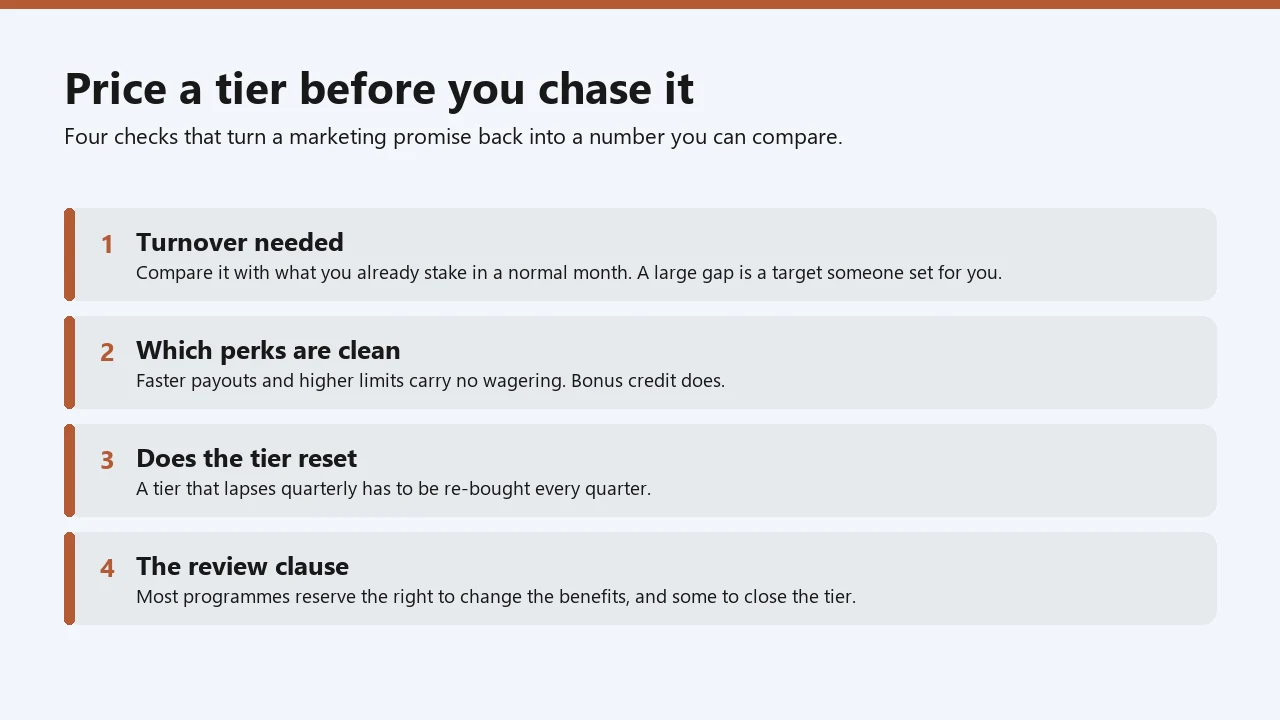
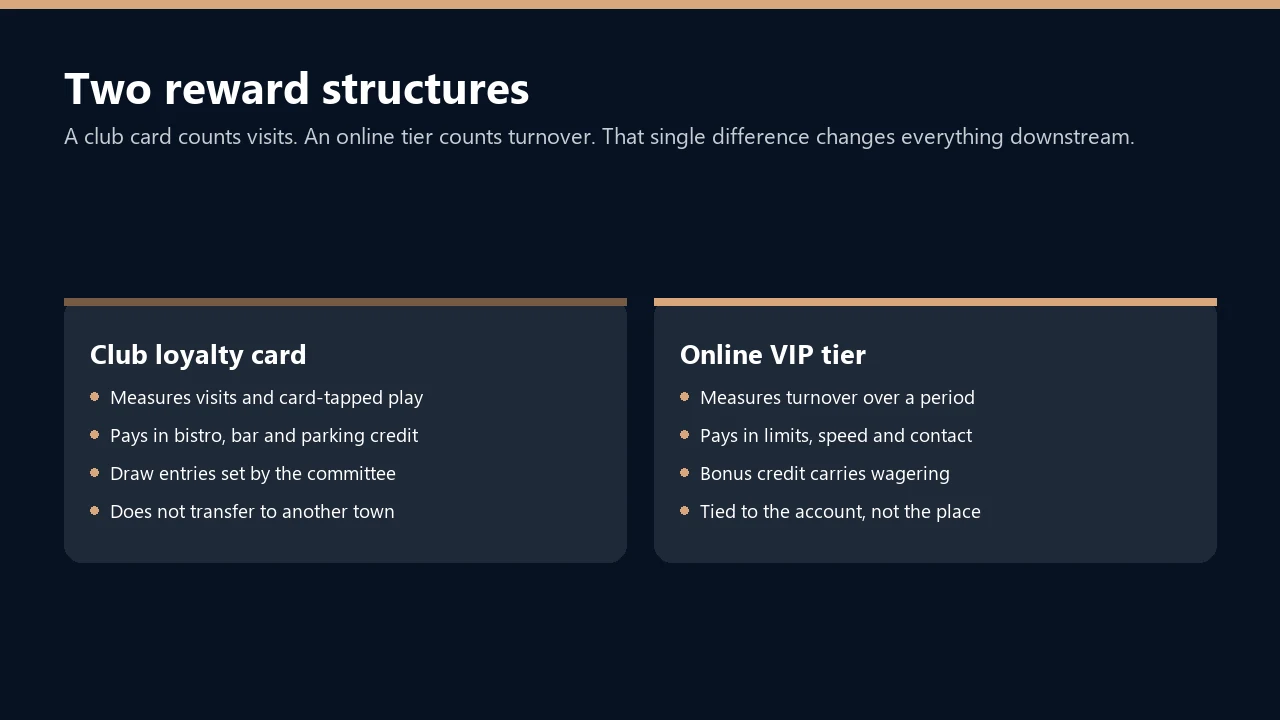
Tiered programmes are one of the few list criteria that genuinely differ between operators and are described in writing, so they are checkable. They are also easy to overvalue: a scheme's worth depends on how much you were going to stake anyway, not on how many tiers it has. We separated the mechanics from the marketing in loyalty tiers versus VIP programmes. Read it before a tier chart moves an operator up your list.
Three things sit permanently outside the reach of this format, and any list that claims them is overreaching.
Whether you will be paid. Published withdrawal terms describe an intention. Whether an operator honours them under pressure — after a large win, during a payment provider outage, when a document is queried — is observable only over time, from a funded account, and only for the conditions that happened to occur. No publisher has that data for ten operators simultaneously, and a star rating is not a substitute for it.
What the games will do. Return figures are long-run properties of a game's maths, not forecasts for your session, and they belong to the game rather than the site. A list cannot improve your odds by ordering operators differently. The game and the stake decide the arithmetic; the operator decides the administration around it.
Whether it suits you. Lists are built for an average reader who does not exist. Your bank, your preferred stakes, how fast you want money back and how much paperwork you will tolerate are all personal, and they are what should decide the question. That is the whole case for spending the ten minutes on your own checks rather than the ten seconds on somebody's ranking.
Used properly, a top ten is a source of candidate names and nothing more — a starting point for the checks in this article, not a conclusion. Our standards for what we will and will not state are set out in our editorial policy. Gambling is for adults only, 18+, and the money you stake should be money you can afford to lose.
No. Online casino games cannot be lawfully offered to people in Australia under the Interactive Gambling Act, so there is no Australian licensing authority publishing or endorsing a ranking of them. Every list you find is a publisher's selection of offshore operators, usually one that publisher has a commercial relationship with.
Because the two pages started from different candidate pools, not because one ranking is broken. An operator that does not run an affiliate programme, or does not accept Australian accounts, will be absent from many lists regardless of quality. Placement is also sold or ordered by commercial value on some sites.
There is no reason to assume it does. Ratings are usually composite scores built from the publisher's own judgements, and withdrawal speed cannot be verified without repeatedly withdrawing from a funded account over time. Read the published withdrawal minimums, caps and processing windows in the terms instead, since those are at least written down.
Pick one number from it — a bonus percentage, a minimum deposit, a named payment route — and look for that same number on the operator's own page. If it is not there, the list has not been re-checked recently, and the rest of its figures deserve the same suspicion.
On its own, nothing. A usable licence statement has three parts: the authority, a licence reference, and the company holding it. You then confirm in the authority's own public register that the company is listed and that the exact domain you are using appears against it. A seal image with no working link to a register proves only that someone pasted an image.
Two is enough: one to use and one as a fallback. Several accounts spread your money and your identity documents across several companies without improving anything. Decide your payment route, smallest acceptable deposit and realistic minimum withdrawal first, then let those three constraints cut the list down.
Advertisement · 18+
A venue has opening hours and a dress code. Online the pokies, the live roulette and the sport are open at any hour, with a demo mode before you stake anything.
See the current offer